
Walk into any big-box home improvement store and you will find rows of kitchen cabinets ready to take home today. They are priced accessibly, they are available immediately, and they look fine in the display. So why would anyone spend significantly more on custom cabinetry?
The answer is not prestige. It is fit, finish, and the long-term relationship your kitchen has with the space it occupies.
Here is an honest breakdown of what you are actually comparing.
What Stock Cabinets Are
Stock cabinets are manufactured in standard sizes, typically in two-inch increments, and produced in high volume. They are available off-the-shelf or with a short lead time. Quality varies by manufacturer, but the construction generally involves particleboard or MDF boxes with face frames or frameless fronts in a limited range of finishes and door profiles.
For a straightforward renovation where the existing layout stays intact and the room dimensions happen to align with standard sizing, stock can work well. Budget is the main driver for most people who choose this route.
What Custom Cabinets Are
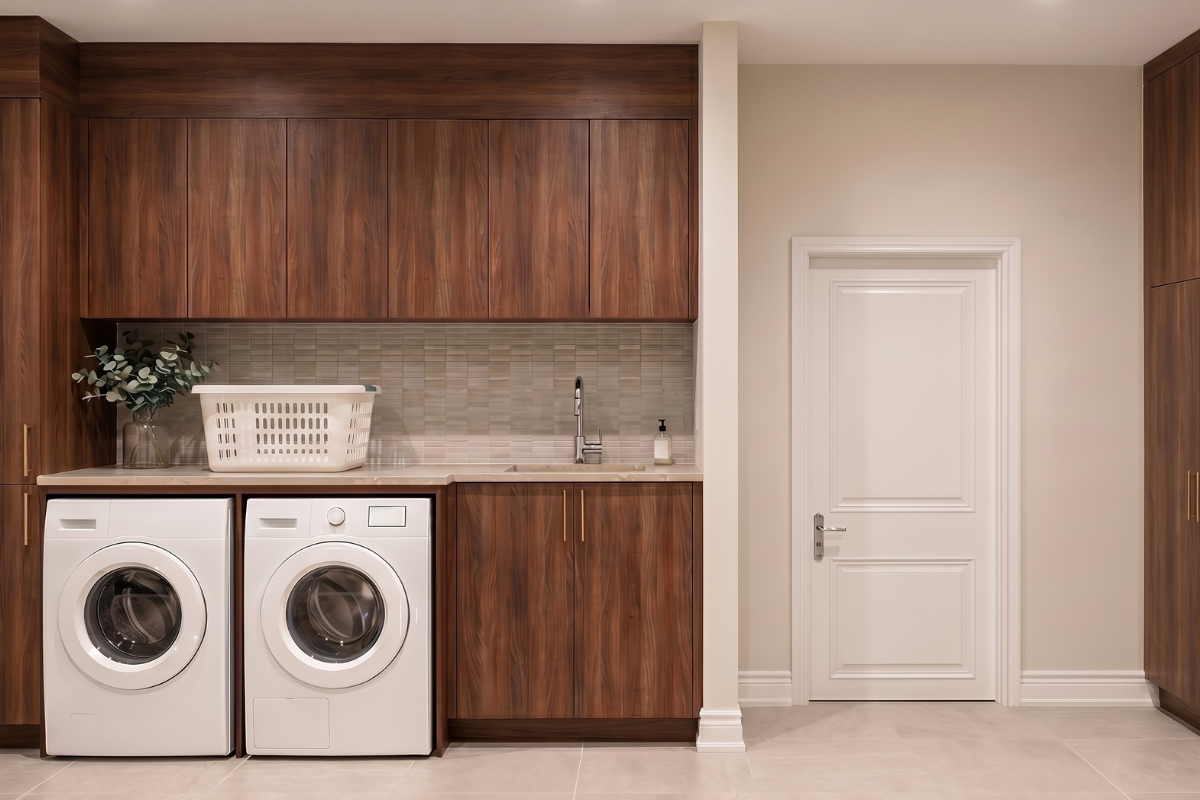
Custom cabinetry is designed and built to your exact specifications. The box dimensions are made to fit your space precisely. The door profiles, finish, and hardware are chosen to suit the specific design of the room. The interior configuration (drawer organization, pull-out shelving, waste management) is designed around how you actually use the space.
Beverly has spent a decade designing and specifying custom cabinetry for clients across Peterborough, Kawartha Lakes, and Northumberland County. The conversations that happen during the design phase are not about choosing a door style from a catalogue. They are about understanding how a family cooks, what gets stored where, and how the kitchen connects to the rest of the home.
The Fit Difference
Most kitchens do not have perfectly standard dimensions. When you install stock cabinetry in a non-standard space, the gaps are filled with filler strips. The uppers may not reach the ceiling, leaving an awkward space above that collects dust and looks unfinished. The island, if there is one, may be constrained by what is available in standard depths.
Custom cabinetry is designed to the room. The lowers sit at the exact height that works for the people using the kitchen. The uppers go where you want them to go. The fillers, if they exist at all, are intentional design elements rather than corrections.
The Finish Difference
Stock cabinetry comes in a limited range of finishes, and those finishes are applied in a factory on standardized components. Wear patterns over time reflect the quality of the materials used.
Custom finishes are specified to match the design intent of the space. Paint, stain, lacquer: the options are broader, and the application is done on components built for that specific project.
The Real Tradeoff
Custom cabinetry costs more and takes longer. If you are renovating on a tight timeline or a limited budget, stock is a legitimate choice, and there are quality stock lines worth considering.
But if you are renovating a kitchen you intend to live with for the next fifteen to twenty years, in a home you have invested in, the case for custom is straightforward. The fit is right. The finish holds. And the design is yours.
A Note on Design-Led Cabinetry
Working with an interior designer on your cabinetry specification means more than selecting a door profile. It means the cabinetry is designed as part of the room, not added into it. The proportions are considered. The hardware is chosen to work with the fixtures and the finishes in adjacent spaces. The layout reflects how the kitchen actually functions.
At Wellington House, cabinetry design is central to how we approach kitchen renovations. If you are considering a kitchen update in Peterborough, Kawartha Lakes, or the surrounding area and want to understand what is possible, a discovery call is the place to start.